Three working languages: English, French and Dutch.
Business engineer by education, thirty years of hands-on IT at every level and across a range of sectors — and one craft: holding together what organisations struggle to keep aligned, business and digital.
On one side, strategy, stakes and decisions. On the other, systems, data and infrastructure. In most organisations the two sides sit next to each other without ever closing: each holds up, neither holds the other. My job is to align them until they become one — the way a zip closes a jacket. And it happens on three levels, never just one: strategy, where decisions are made; the programme, where the work is organised; the project, where it is delivered. I have worked at all three, often within the same assignment.
I set things up; I don't maintain them. I have never been CEO or CIO in title, and that is no accident: what interests me is the moment an organisation has to build, realign or optimise — while staying permanently in touch with the context, the market and the state of technology.
One profile, several facets.
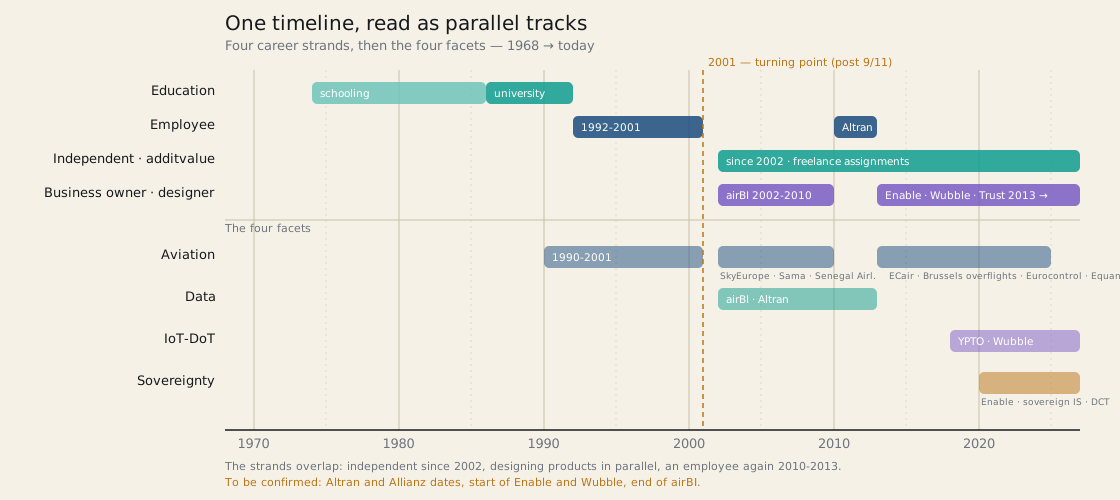
One timeline, read as parallel tracks. The strands overlap; 2001 is the turning point. Swipe to scroll through the timeline.
Four words, and what they stand for.
The four words below set out what the title means.
Versatile
Getting up to speed fast. Broad everywhere, deep where it counts — in aviation I am operational instantly; elsewhere the ramp-up is short. I don't need familiar ground or stable frameworks to perform.
Industries — aviation, rail, energy, banking and insurance, pharma
Geographies — Belgium, France, Central Europe, Saudi Arabia, Africa
Languages — French mother tongue; English and Dutch at bilingual level, fully at ease in English-only or Dutch-only teams
Not "IT": broader than infrastructure. None of it was in the curriculum; I learnt it because a product had to work — far enough at each level to design, arbitrate and troubleshoot without a go-between.
Solution architecture — Altran, Sama, choosing a PSS
Data and management reporting — airBI, Altran
IoT-DoT — from the circuit board to the dashboard
Infrastructure and AI — self-hosted, self-taught
Business
The degree is the mould: a business engineer speaks the language of every player in the business world. The rest is practice — business owner since 2002, and assignments where decisions were taken at executive level.
Solvay 1992, summa cum laude
additvalue SRL since 2002
Eurocontrol — policy reports for transport ministers
Sama — vendor selection, contract, implementation
YPTO — IoT programme portfolio
Professional
Three strands in parallel — employee, independent, business owner — and one way of operating: I get sent where there is nobody to help. I don't create dependency on myself; what I set up keeps working after I leave.
Thinker and doer — head in the stars, feet on the ground
Both sides of the mirror — the architect who has also been an entrepreneur
Where business and digital have actually closed. Each has its own page.
Aviationsince 1992
A puzzle that began with a thesis on hub and spoke, entered through network, yield and the field before technology. Broad rather than deep, and deliberately so — with three areas of real depth: the sector's IT, yield management, information systems. And an industry that forgives nothing.
Eleven years — airBI, business intelligence for airlines, from the call centre to the board; then Altran, as a data solution architect. Linking an operational decision to the figure behind it.
I came in through rail mobility at YPTO, then through my own developments, to find out what is inside the box. Wubble was born of that question: objects that talk to each other with or without a connection, and that don't stop working because an operator has stopped serving them.
I don't start from the assumption of an outage; I start from a place where there was never anything to plug into. Five levels of digital autonomy, one question — which level are you on, and what would it take to hold one level lower? — and a sovereign information system, applied first to myself.